Moles: What are they?
The moles, also known as “nevi,” are a common finding on the skin of people of all ages. They are clusters of melanocytes, the cells responsible for the production of melanin – the pigment that gives the skin its natural color. Most moles are benign and do not cause concern. However, some may undergo changes in appearance or structure, which requires medical evaluation, as they may indicate a malignant transformation.
Types of Moles
There are different types of moles, depending on their shape, location and characteristics:
- Congenital: They are present at birth or appear during the first months of life. They may be small or extensive. Very large congenital moles require more frequent monitoring due to an increased risk of malignancy.
- Acquired: They develop after birth, usually during childhood or adolescence, and are the most common type.
- Dysplastic: They present atypical morphology, uneven color and irregular borders. They are considered warning indicators of an increased risk of developing melanoma.
- Blue: They have a blue-black color, caused by the deeper location of melanocytes within the skin.
- Junctional or intradermal: Depending on the depth at which the melanocytes are located, moles may appear flat or raised.
Moles: How do they form?
The appearance of moles is mainly related to genetic factors and sun exposure. UV rays affect the melanocytes, causing increased melanin production and, in some cases, localized cell accumulation that forms moles. The hormonal factor also plays a role, as new moles often appear during puberty or pregnancy.
Excessive exposure to ultraviolet radiation without sunscreen protection increases the risk of dysplasia and possible malignancy.
When is medical evaluation necessary
Most moles remain stable in size, color and shape. However, any change in appearance should prompt the patient to seek evaluation by a dermatologist. The internationally recognized ABCDE system helps with self-examination:
- A – Asymmetry: If the mole does not have a symmetrical shape.
- B – Border: If the borders are irregular or unclear.
- C – Color: If there are different shades or darker areas.
- D – Diameter: If it exceeds 6 millimeters.
- E – Evolution: If there is a change in size, color, or texture over time.
Additionally, bleeding, itching, or pain are signs that require immediate evaluation.
Moles in children
These marks in children are usually benign and do not require removal. However, it is important for parents to regularly monitor any changes and to protect their children from excessive sun exposure, especially without sunscreen protection. Certain types, such as congenital melanocytic nevi, require periodic examination, as the possibility of malignancy, although small, is real.
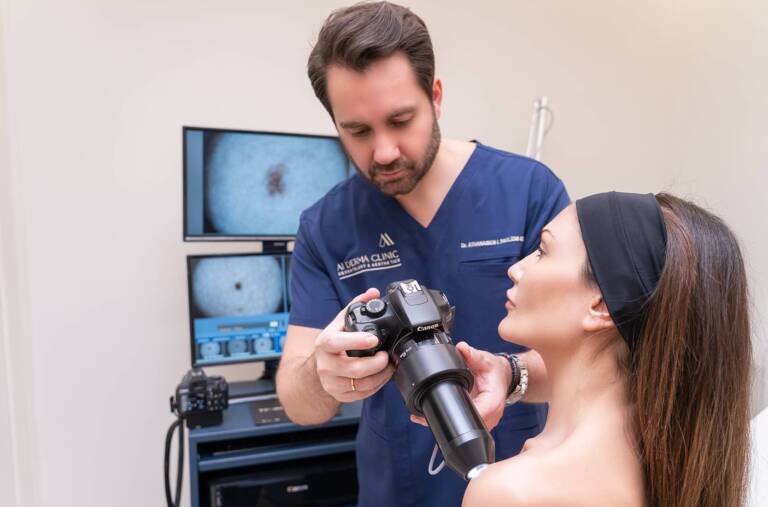
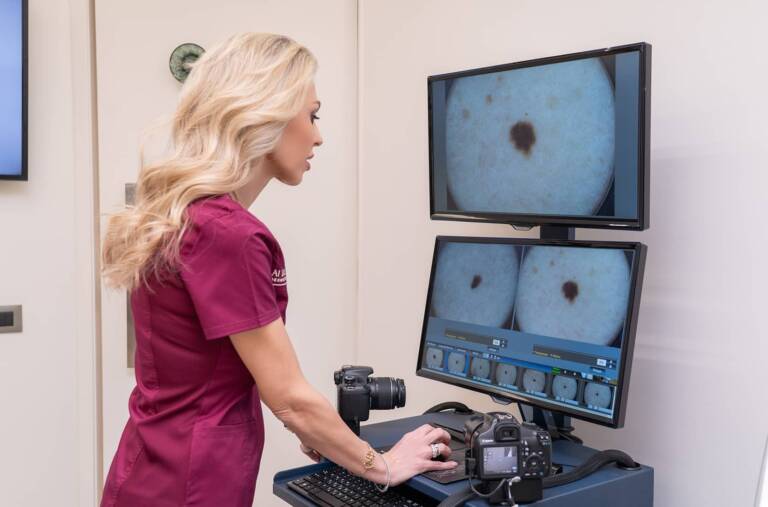
At AI Derma Clinic, we perform full-body mole mapping, a procedure that allows for detailed imaging, documentation, and comparison with previous images to enable the early detection of changes.
Diagnosis and mole mapping
The clinical examination by a dermatologist includes a skin inspection using a dermatoscope, a special instrument that allows for detailed observation of the surface and the features of the mole.
In cases with multiple or suspicious moles, digital mole mapping is recommended, which photographically records each mole and stores the data for future comparison.
In cases with multiple or suspicious moles, digital mole mapping is recommended, which photographically records each mole and stores the data for future comparison.
Removal of moles
The removal of moles is recommended when:
- there are suspicious features that indicate a possible malignant transformation,
- the mole is repeatedly injured or irritated (e.g., by clothing or shaving),
- it causes an aesthetic concern for the patient.
Surgical removal: The entire mole is excised within healthy margins. This method also allows for histological examination to rule out malignancy. The procedure is painless and usually performed under local anesthesia.
Prevention and skin protection
The prevention plays a crucial role in maintaining skin health and in preventing malignant transformation of moles. The main recommendations include:
- Use of sunscreen with a high protection factor throughout the year, even in winter.
- Avoiding sun exposure during peak hours (11:00–16:00).
- Hat and clothing that cover the skin when there is intense radiation.
- Avoiding solarium use, which emits ultraviolet radiation.
- Regular dermatological examination, especially for individuals with many moles, a family history of melanoma, or fair skin.
A self-examination once a month in front of a mirror helps in the early detection of changes.
Moles and melanoma
Melanoma is the most dangerous form of skin cancer, originating from melanocytes. Although it can appear on normal skin, it often develops from a pre-existing mole. Early detection is crucial: when identified early, melanoma is completely curable.
Regular monitoring, mole mapping and protection from ultraviolet radiation are the main defenses against the disease. Dermatologists emphasize that preventive removal of a mole without signs of alteration does not reduce the risk of developing melanoma, unless there is medical justification.
For any questions or if you notice changes in your moles, contact the experienced dermatologists at AI Derma Clinic, Dr. Athanasios I. Pavlidis and Dr. Konstantina Mamali. With extensive experience in Dermatology and Dermatologic Surgery, specialization in Dermatoscopy and Mole Mapping, and the use of state-of-the-art medical equipment, they provide a comprehensive and safe approach to mole diagnosis and removal. Trust them for timely prevention and accurate evaluation of any skin lesion, in an environment of high scientific expertise and care. Contact AI Derma Clinic today to schedule your appointment.